Agentic Commerce + CRO
Agentic Commerce Will Expose Weak Product Pages Before It Fixes Them
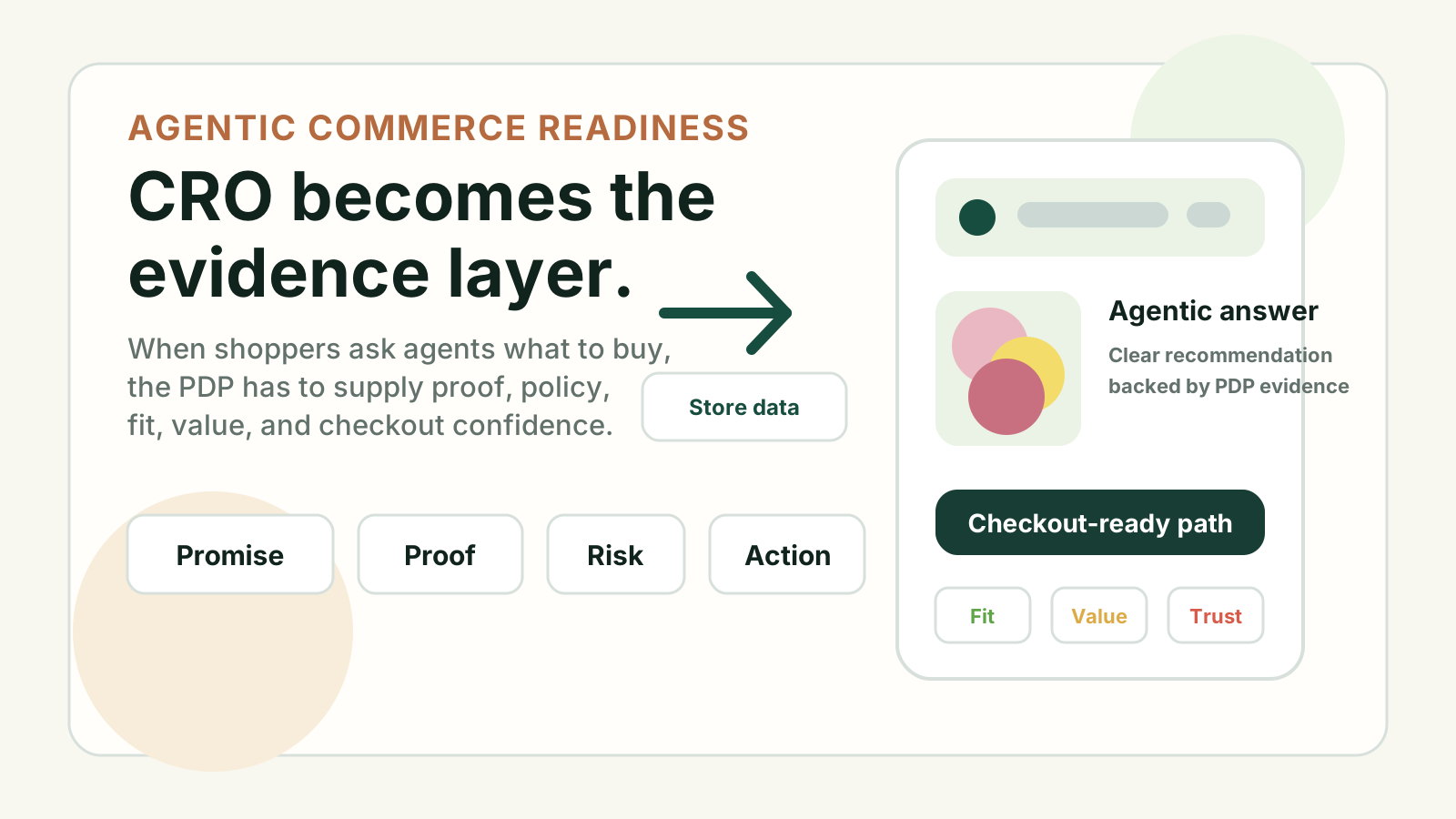
Agentic commerce is becoming one of the biggest shifts in ecommerce discovery. Buyers are no longer only clicking ads, landing on websites, opening product pages, and deciding from there. They are also asking assistants, recommendation engines, search experiences, and conversational storefronts what to buy, what fits their needs, which option is better, and whether a product is worth the price.
That sounds like a channel shift. It is also a CRO shift.
If an agent is going to recommend a product, summarize a policy, compare options, or guide the buyer toward checkout, it needs useful evidence. It needs a clear product promise. It needs structured product data. It needs proof, fit information, pricing context, delivery expectations, return rules, material details, customer confidence signals, and a purchase path that feels safe enough to complete.
In other words, the work that makes a product page convert is the same work that makes the product page understandable to agentic commerce systems. Agentic commerce does not remove the need for CRO. It raises the standard for it.
What "agentic" means in plain English
Agentic describes software that can pursue a goal through a sequence of steps instead of only returning a single answer. A basic search box reacts to keywords. A traditional chatbot answers questions. An agentic system can interpret what the buyer is trying to accomplish, decide what information it needs, compare options, ask for clarification, recommend a next step, and sometimes move the shopper closer to checkout.
In commerce, that means the buying journey starts to feel less like browsing a catalog and more like working with a guided assistant. A shopper might say, "I need a durable gift under $75 that can arrive by Friday and will not be hard to return." An agentic commerce system has to translate that request into product fit, price, delivery promise, policy confidence, proof, and availability before it can recommend anything useful.
That does not mean buyers disappear or product pages stop mattering. It means more of the shopper's decision is mediated by systems that need reliable source material. The agent can only reason from what the store makes clear: product attributes, use cases, reviews, policies, price logic, inventory, delivery expectations, and checkout trust signals.
A simple way to think about it: agentic commerce is ecommerce where software does more of the shopping work with the buyer. It can help narrow, compare, explain, and guide. But if the underlying product truth is thin, vague, or scattered, the guidance will be thin too.
What agentic commerce actually changes
Swap Commerce is positioning agentic storefronts around guided buying journeys, shopper intent, and storefront experiences that adapt to the customer. Shopify is pushing a related direction through its Agentic Commerce plan, where store data can be made available to AI chat and discovery surfaces so buyers can search, compare, and buy closer to the conversation.
The common thread is not just automation. It is decision support. The buyer asks a question. The commerce system needs to interpret intent. Then it needs to return an answer, recommendation, product, policy, or checkout path that reduces uncertainty enough for the buyer to move forward.
This changes the role of the product page. The PDP is no longer only a destination after the click. It becomes a source of truth that feeds discovery, comparison, recommendation, and purchase confidence across more surfaces.
If the PDP is vague, thin, or badly sequenced, agentic commerce has less useful material to work with. If the PDP is clear, evidence-rich, and structured around buyer questions, the store is easier to recommend, summarize, and trust.
CRO moves from page polish to decision evidence
For years, many CRO conversations have been trapped in surface-level debates: button color, hero layout, section order, homepage modules, or whether a page feels modern enough. Those things can matter, but they are rarely the whole constraint.
The deeper constraint is usually evidence. The buyer does not have enough information to believe the product is right, safe, proven, worth the price, and easy to buy. The page may look good, but the buying argument is incomplete.
Agentic commerce makes this more obvious. When a shopper asks, "Which of these should I buy?" or "Is this worth it for my situation?" the answer cannot be powered by a beautiful layout alone. The answer has to be powered by product evidence.
That means CRO has to become more disciplined. The question is no longer only, "Does this page look better?" The better question is, "Does this product page contain the decision evidence a shopper or agent would need to recommend, compare, and buy with confidence?"
The product page is becoming a distribution asset
A strong PDP used to be primarily about onsite conversion. It still is. But now it also affects how the product can be understood outside the page itself.
If product data is syndicated into AI chat surfaces, shopping assistants, search experiences, or guided storefronts, the quality of the underlying evidence matters. Product title, description, variants, price, inventory, reviews, policies, specifications, media, and structured metadata become part of the buyer's decision path.
A thin page creates thin answers. A generic product promise creates generic recommendations. Buried return policies create uncertainty. Missing size, dimension, compatibility, or material details create hesitation. Weak proof gives the agent little reason to distinguish the product from alternatives.
The PDP has to carry more than content. It has to carry evidence.
The seven evidence layers agentic commerce needs
To prepare for agentic commerce, start with the same decision signals that make a product page convert today. These are the layers a shopper uses to decide whether a product is clear, safe, proven, worth the price, and right for their situation.
1. Product promise. The page should explain what the product is, who it is for, what outcome it supports, and why it matters. A product title alone is not enough if it leaves the buyer to infer the real value.
2. Product proof. Reviews, customer photos, examples, outcome language, use cases, and credibility signals help the buyer believe the product does what the page implies it will do. Agentic surfaces need proof that is specific enough to summarize and compare.
3. Fit and suitability. Size, dimensions, compatibility, material, quantity, included items, care instructions, and usage context reduce the practical doubt that stops purchases. This matters for fashion, home goods, stationery, gifts, tools, beauty, and almost every product category.
4. Risk reduction. Shipping, returns, delivery timing, guarantee, support, payment safety, and store legitimacy all reduce the fear of being stuck with the wrong product. If those details are buried, the page is harder to trust and harder to summarize.
5. Value context. Price needs a reason. Quality, durability, craftsmanship, bundle logic, use frequency, outcome, convenience, and proof can all explain why the product deserves the price.
6. Comparison logic. Buyers and agents both need to know how this product differs from alternatives. That can be done through specs, "best for" guidance, variant explanations, bundle framing, or a clear reason to choose one option over another.
7. Purchase readiness. The next step should be obvious and supported. Add to cart, add to basket, add to bag, checkout, delivery expectation, returns, and payment confidence all contribute to the moment where interest becomes action.
Where weak product pages will get exposed
Agentic commerce will not be kind to vague merchandising. If the page does not clearly answer buyer questions, the system may still show the product, but the recommendation will be weaker. The product may be described generically. The answer may lack confidence. The buyer may still need to leave the conversation and inspect the site manually before deciding.
Here are the gaps that will become more visible:
- Generic product descriptions: They make it difficult to explain why the product is better, different, or right for a specific use case.
- Missing specs: They block fit, size, compatibility, quantity, and material confidence.
- Weak proof: Reviews exist, but they do not answer the objections shoppers actually have.
- Buried policies: Shipping, returns, guarantee, and support details are technically present but too hard to find.
- Unclear variant logic: Buyers do not know which option is right, and the system has little basis to guide them.
- Unstructured value: The page shows price without enough reason to believe the price is fair.
- Unsupported CTAs: The purchase action is visible, but the confidence cues around it are too thin.
How to prepare a product page for agentic commerce
The first move is not to chase every new channel. The first move is to improve the product evidence that every channel depends on.
Start with one product page that already receives meaningful traffic. Audit it as if a buyer is asking an assistant, "Should I buy this?" Then identify the missing evidence that would make the answer stronger.
Use this practical checklist:
- Rewrite the first product promise so the outcome and buyer relevance are clear in plain language.
- Add or improve product specifications that answer size, fit, material, quantity, compatibility, or usage questions.
- Move proof closer to the moment of hesitation, especially near the buy box and first-screen decision area.
- Summarize shipping, returns, guarantee, and support details in language a buyer can understand quickly.
- Make value visible through quality cues, included items, use cases, bundle logic, or outcome framing.
- Clarify variant differences so the buyer knows which option fits their use case.
- Make the purchase CTA easy to identify and surround it with enough confidence to click.
- Keep product data, policies, inventory, and media consistent across the store so external discovery surfaces are not working from stale information.
What this means for Shopify and ecommerce teams
The teams that win in agentic commerce will not only be the teams with access to new distribution. They will be the teams with cleaner product truth.
That means product, merchandising, CRO, content, analytics, and operations have to work together. A product page cannot be treated as a one-time content upload. It has to become a maintained decision asset.
When a product page is weak, the team should not simply redesign it. The team should ask: which decision signal is missing, which buyer doubt does it create, where should the evidence appear, and what metric should improve if we fix it?
That is how agentic commerce connects back to CRO. The same evidence that helps an onsite visitor buy also helps a recommendation system explain, compare, and guide the buyer.
The operating question to ask now
The right question is not, "Will agentic commerce replace the product page?" The right question is, "Is our product page good enough to be used as the source material for a recommendation?"
If the answer is no, the next step is not panic. The next step is a structured PDP audit. Find the evidence gaps. Rank the missing signals. Improve the product truth. Then make sure the page can support both the human shopper and the systems helping that shopper decide.
Agentic commerce will reward stores that are easier to understand, easier to trust, and easier to buy from. That is CRO work. It just has a bigger distribution surface now.
Recommended path
Prepare the PDP evidence layer
Use these guides to connect agentic commerce readiness with product-page trust, first-screen clarity, and decision-first CRO execution.
Check whether the product page has the clarity, proof, risk reduction, value, and action signals a buyer needs.
First screen The Product Page First-Screen TestSee whether the first view creates enough confidence before shoppers, assistants, or search surfaces move on.
Audit workflow A Shopify CRO Audit Should End With DecisionsTurn product-page observations into a ranked fix list, owner-ready actions, and a 30-day execution plan.
Audit one product page for agentic commerce readiness.
Use the free PDP CRO audit to inspect the evidence layer that shoppers, storefronts, search, and buying assistants need before they recommend or buy.
Try the PDP CRO Platform