Product Page CRO
The 7 Buying Signals Every Product Page Needs Before Shoppers Trust It
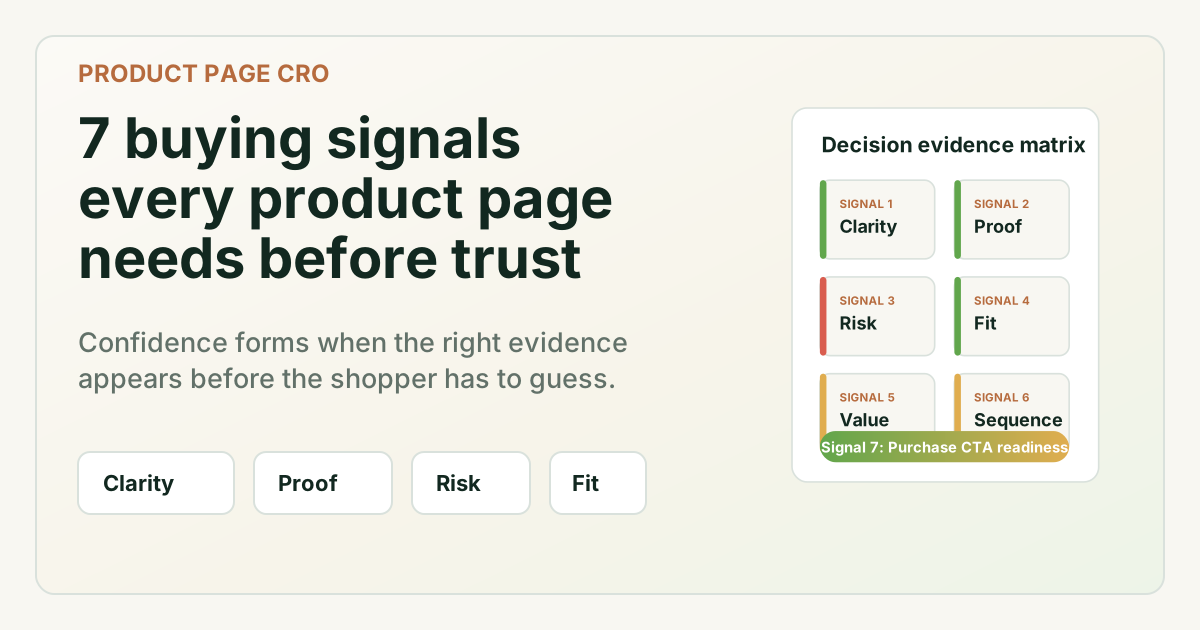
A shopper does not trust a product page because it has a nice layout. They trust it when the page gives them enough evidence to believe the product is clear, safe, proven, worth the price, and right for their situation.
This is why many product pages underperform even when the product itself is good. The page may create interest, but interest is not the same as purchase confidence. Before a shopper clicks add to cart, the page has to answer the practical and emotional questions that sit between curiosity and commitment.
The fastest way to audit a product page is to stop asking whether the page looks complete and start asking whether the seven buying signals are strong enough.
Buying signals are the evidence behind trust
A buying signal is a piece of page evidence that helps the visitor move closer to a decision. It might be a clear product promise, a useful review, a delivery promise, a return policy, a size detail, a material explanation, a guarantee, a customer photo, or a CTA that appears at the right moment.
These signals are not decorative checklist items. They are the operating system of the product page. When the signals are clear, the shopper can move from inspection to action. When they are weak, buried, generic, or out of order, the shopper has to fill in the blanks.
That is where hesitation begins.
Signal 1: Product clarity
The first buying signal is clarity. The shopper should quickly understand what the product is, who it is for, what problem it solves, and why it matters. If the page asks the visitor to infer the value from a title, a photo, and a price, it is creating unnecessary work.
Clarity does not mean long copy. It means the first screen gives the buyer enough orientation to keep evaluating. The product title, short description, price context, visual hierarchy, and first CTA should work together. A visitor should not need to scroll deeply before understanding the product promise.
When clarity is weak, visitors may still browse, but they do not build confidence. They may like the look of the product without knowing whether it is the right product for them.
Signal 2: Proof
Proof is the evidence that the product does what the page implies it will do. Reviews, customer photos, testimonials, press mentions, usage examples, before-and-after context, and outcome language can all serve as proof. But proof only works when it answers a buyer question.
Generic reviews are weaker than objection-specific reviews. A review that says "love it" is nice. A review that explains quality, sizing, durability, giftability, comfort, packaging, delivery, or real use is more useful. The page should use proof to reduce uncertainty, not simply to show that reviews exist.
Proof also has to be close enough to the decision it supports. If shoppers worry about quality near the buy box, proof buried far below the fold may not help at the moment of hesitation.
Signal 3: Risk reduction
Every purchase carries risk. The shopper may worry about shipping time, returns, payment security, product quality, support, fit, compatibility, or whether the store is legitimate. A product page earns trust when it names and reduces those risks before the buyer has to hunt for reassurance.
Shipping and returns are not back-office details. They are conversion signals. A guarantee is not just legal language. It can be permission to commit. Customer support copy is not filler. It tells the shopper whether help is available if something goes wrong.
If risk signals are hidden in footer links or long policy pages, the page may feel riskier than the business actually is.
Signal 4: Fit, size, or compatibility confidence
Every category has a version of fit. For apparel, it may be size, cut, model context, stretch, and body reference. For stationery, it may be dimensions, paper type, envelope details, and use case. For home goods, it may be scale, measurements, materials, room context, or care. For electronics, it may be compatibility, setup, and requirements.
Fit confidence matters because it reduces the chance that the shopper imagines the product incorrectly. The more uncertainty the buyer has about scale, size, material, compatibility, or suitability, the easier it becomes to delay the purchase.
A strong product page does not make the buyer search for practical information. It places the practical answers close to the moment the buyer needs them.
Signal 5: Value confidence
Price is easier to show than value. A page can display the price clearly and still fail to explain why the product is worth it. Value confidence comes from connecting the product to quality, usefulness, durability, outcome, convenience, scarcity, bundle logic, or emotional reward.
This is especially important for premium products, giftable products, technical products, and products that are easy to compare. If the page does not defend the value, the buyer may compare only on price.
Value confidence does not always require discounting. Often, it requires clearer proof, better explanation, stronger media, more specific benefits, or a more believable connection between the product and the result the buyer wants.
Signal 6: Decision sequence
The order of information matters. A page can contain the right pieces and still lose momentum if they appear too late. This is especially true on mobile, where every scroll changes what the shopper remembers, sees, and trusts.
The decision sequence should move the buyer from product clarity to proof, risk reduction, fit confidence, value confidence, and action. If the page asks the shopper to scroll through long description depth before seeing policy confidence, review proof, or a strong CTA, the buying path may feel harder than it needs to be.
A good product page is not just a collection of modules. It is a sequence of confidence-building moments.
Signal 7: Purchase CTA readiness
The purchase CTA is the final signal, but it does not work alone. A button can be visible and still feel premature if the page has not built enough confidence around it. The CTA becomes stronger when the surrounding evidence makes the next step feel obvious.
The page should make it clear what action the shopper can take, what they are buying, what happens next, and why it is safe to proceed. Add to cart, add to basket, and add to bag all function as purchase CTA evidence when they are visible and supported by the right confidence cues.
If the CTA is competing with unanswered doubts, the page has an evidence problem, not just a button problem.
How to audit the seven signals
Start with one product page that gets traffic but does not convert as well as it should. Do not begin with a redesign. Begin with a signal check.
For each signal, ask three questions: is the signal present, is it specific enough to reduce doubt, and is it placed where the shopper needs it? A detected signal is not always a strong signal. Reviews can exist and still fail to answer objections. Shipping copy can exist and still fail to reduce anxiety. Dimensions can exist and still be too hard to find.
The output should be an evidence-ranked fix list. Name the missing or buried signal, identify the buyer doubt it creates, decide where the evidence should appear, and define the metric that should move if the fix works.
How to use this in the PDP CRO Platform
The PDP CRO Platform was built around this decision-signal logic. The free audit checks a product page for buying signals, surfaces evidence gaps, and gives you a clearer first read on why shoppers may hesitate.
Use it on one product page, then inspect the evidence matrix, executive insight, and prioritized findings. The goal is not to collect another score. The goal is to find the buying signal that should be fixed first.
Recommended path
Keep building the product-page trust path
These articles connect buying signals, first-screen clarity, and practical evidence placement so the page earns the next click.
See why buying signals now matter across product pages, storefronts, search, and agentic recommendation surfaces.
Evidence layer Product Pages Need Better Buying EvidenceTurn vague product-page polish into concrete evidence that answers buyer hesitation.
Next diagnostic The Product Page First-Screen TestCheck whether shoppers see enough clarity, proof, risk reduction, and action before they scroll.
Audit your PDP against the 7 buying signals.
Run the free PDP CRO audit to inspect product clarity, proof, risk, fit, value, sequence, and purchase CTA readiness for a real product page.
Try the PDP CRO Platform